This month we welcomed Ruth Cornett, one of our own members, who talked to us about Flowers in Art, building on some of the themes she had developed in an earlier presentation.
Ruth demonstrated that, over the years, artists have used flowers in their work to indicate and symbolise a range of meanings, from simple decoration to literary references. Depending on the context, flowers have been used to deliver a hidden message, promote certain ideas, to educate, to convey a Christian story or describe the cycle of life. Ruth’s presentation used one or two paintings to illustrate each of these themes.

by his royal gardener, John Rose
Hendrick Danckerts, 1675
One of the earliest examples Ruth used was that of King Charles II being presented with a pineapple by the Royal Gardener, John Rose, in the formal gardens of an estate, painted around 1677. Here we could see one of the oldest representations of an English garden, although as Ruth pointed out, at this time English gardens were heavily influenced by Dutch ideas. In depicting a workman on his knee offering a rare fruit to the King, this painting encapsulates power, control, education and status.
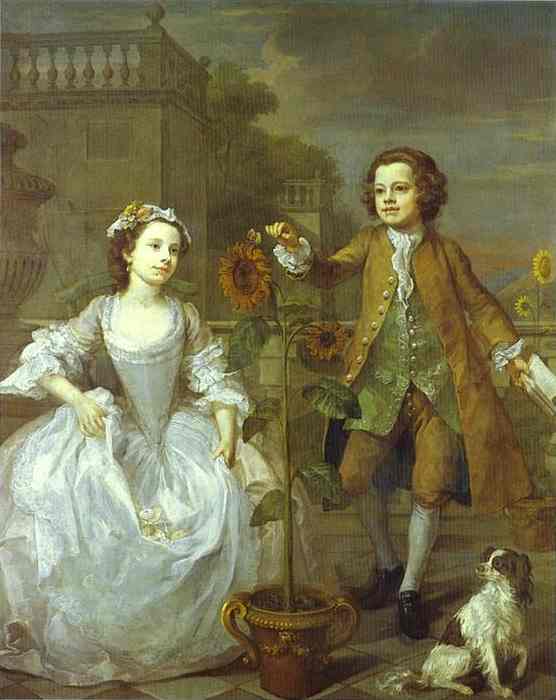
William Hogarth, 1747
Hogarth’s The MacKinen Children (1747) depicts the children of a sugar plantation owner from Antigua, separated from their parent by distance and conveying an altogether different message. Although the background features a grand building indicating the wealth of the family, here the sunflower, turning to the sun, reminds us that the children are remembering their father, while the dog symbolises fidelity. Often associated with youth, innocence and purity, Ruth also drew our attention to Murillo’s portrait of The Flower Girl (1665) where a young girl holds a bunch of flowers in her shawl – a painting all the more poignant as this was Murillo’s only daughter who was born deaf and later became a nun in the Dominican order.

The above portrait of Ginevra de’ Benci by Leonardo da Vinci (1474-1478) demonstrates how a painting could simply be a play on a person’s name. It was thought this portrait of a young woman, Ginevra, was commissioned on her engagement. In Renaissance Italy, the juniper was regarded a symbol of female virtue, while the Italian word for juniper, ginepro, also refers to Ginevra’s name.

Jan Brueghel the Younger, c. 1640
Ruth went on to discuss the meticulously detailed work of Albrecht Durer (1471 – 1528) who demonstrated how the painted image could record features of the natural world. By the early 17th century, ‘herbals’ gave the names and descriptions of plants usually with information on their uses, accompanied by illustartions. In 1561 one of the earliest images of a tulip appeared in one of these herbals, but by 1614 the high demand for these plants ensured that they featured far more widely in paintings throughout northern Europe. As Ruth pointed out, more than a single talk could be devoted to the history of tulips alone and she touched briefly on their popularity leading to the ‘tulip mania’ of the 1630s where prices of bulbs soared astronomically, before the market finally collapsed. The painting above by Breughel the Younger offers a satirical commentary. On the left one monkey points to flowering tulips while another holds up a tulip and a moneybag. Bulbs are weighed, money is counted, a lavish business dinner is enjoyed. But on the right, a monkey urinates on the now worthless tulips, while fellow speculators in debt are brought before the magistrate or weep in the dock.

Ambrosius Bosschaert, 1614
Many people may be familiar with the work of Ambrosius Bosschaert (1573 – 1621) and his beautiful still lifes. Ruth used his Still-Life of Flowers to draw together some of the themes discussed. Here are a pink carnation, a white rose, and a yellow tulip with red stripes lying in front of a basket with flowers that would not bloom together: roses, forget-me-nots, lilies-of-the-valley, a cyclamen, a violet, a hyacinth, and tulips. Insects, short-lived like flowers, are included to remind the viewer of the brevity of life and the transience of its beauty, while the butterfly symbolizes the soul.
Of course, flowers have been used extensively in paintings based around literary figures and in Christian themes. Ruth referred us to Millais’ painting of Ophelia (1852) to illustrate the former and Crivelli’s Virgin and Child (1491) for the latter. She also referred us to a fascinating article on the Plane Curator website: A Species List for Millais’ Ophelia.

Giuseppe Arcimboldo, 1590-91
Ruth also introduced us to the extraordinary work of Giuseppe Arcimboldo (1527 – 1593), whose influence extended into the twentieth century. His series The Four Seasons uses fruit and vegetables to form human portraits. Vertumnus, a portrait depicting Rudolf II, used earthly fruit and vegetables to demonstrate that as well as being king, Rudolf could also harness the power of the earth.
Ruth’s final example brought us into the twentieth century. In Hockney’s Mr. and Mrs. Clark (1971) she demonstrated how flowers continue to be used as motifs. Hockney drew on both the Arnolfini Portrait by Jan van Eyck and A Rake’s Progress by William Hogarth in the symbolism and composition of his painting. Hockney’s portrait, with the woman standing and the man sitting, also reverses the convention of traditional wedding portraiture. The lilies next to Birtwell are a symbol of female purity – at the time of the portrait Birtwell was pregnant. The cat “Percy” (slang for penis) sits erect on Clark’s crotch. The cat is a symbol of infidelity and envy, echoing the dog (a symbol of fidelity) which appears in the Arnolfini Portrait. In this case, Clark continued to have affairs with men and women, which contributed to the breakdown of the marriage: Hockney depicts the couple together, but the composition foreshadows their divorce.

Thanks to Ruth for an interesting and enlightening talk – it opened our eyes to so much background and detail that lies beyond the sheer beauty of the flowers in these paintings!
Vija V
Discover more from Charlton and Blackheath Amateur Horticultural Society
Subscribe to get the latest posts sent to your email.
 Charlton and Blackheath Amateur Horticultural Society
One thought on “October 2025 Talk: Flowers in Art”