We hope you enjoy walking around the walled gardens at Charlton House!
This month, look out for:
New England Aster (Symphyotrichum novae-belgii ‘Violetta’)

‘Violetta’ is a spectacular New England aster, which for a couple of months from late summer, bears a prolific display of violet-purple daisies. A naturally tall plant, it provides a regal purple splash of colour – long after many other perennials have finished flowering. Our plants are originally a donation from CABAHS member Anne.
Michaelmas daisy (Aster x frikartii ‘Monch’)

A bushy perennial with clusters of yellow-centred, lavender-blue daisies that flower right through the Autumn, it is very attractive to pollinators. One of the most reliable and popular Michaelmas daisies (so called because they flower at the time of the feast of Michaelmas on 29 September), it was bred by a Swiss nurseryman called Frikart and named ‘Monch’ after a Swiss mountain.
Calico aster (Symphyotrichum lateriflorum) Lady in Black
Dark purple dagger-like foliage that emerges in spring, developing through summer as the stems grow before masses of small white daisy flowers with rosy pink centres burst from tiny buds in autumn. We now have several plants in the Peace Garden beds. A tough plant preferring a free draining soil and full sun. Bees absolutely love it.

Sedum / stonecrop (Hylotelephium ‘Matrona’)

This drought tolerant “ice plant” with leafy, reddish stems has multiple, tiny, soft pink flowers which fade to deeper pink as they age (look closely – they are like tiny stars). It’s always covered in bees, which love the flowers! Dormant in winter, it can survive very cold temperatures. These were part of the original planting scheme in the early 2000s. They have been attacked by vine weevil but we treated with nematodes and they seem to have recovered.
Lily turf (Liriope muscari)

Grass-like evergreen leaves (hence the name “turf”), with spikes of long-lasting, lilac-purple flowers, similar to grape hyacinths. This plant is actually a member of the Asparagus family! It makes attractive ground cover, and is great for dappled shade. The clump in Bed A under the Tree of Heaven was formed from a single donation by a CABAHS member three years ago. We are now trying it in other beds.
And still going strong:
Persicaria (Bistorta amplexicaulis ‘Firetail’)
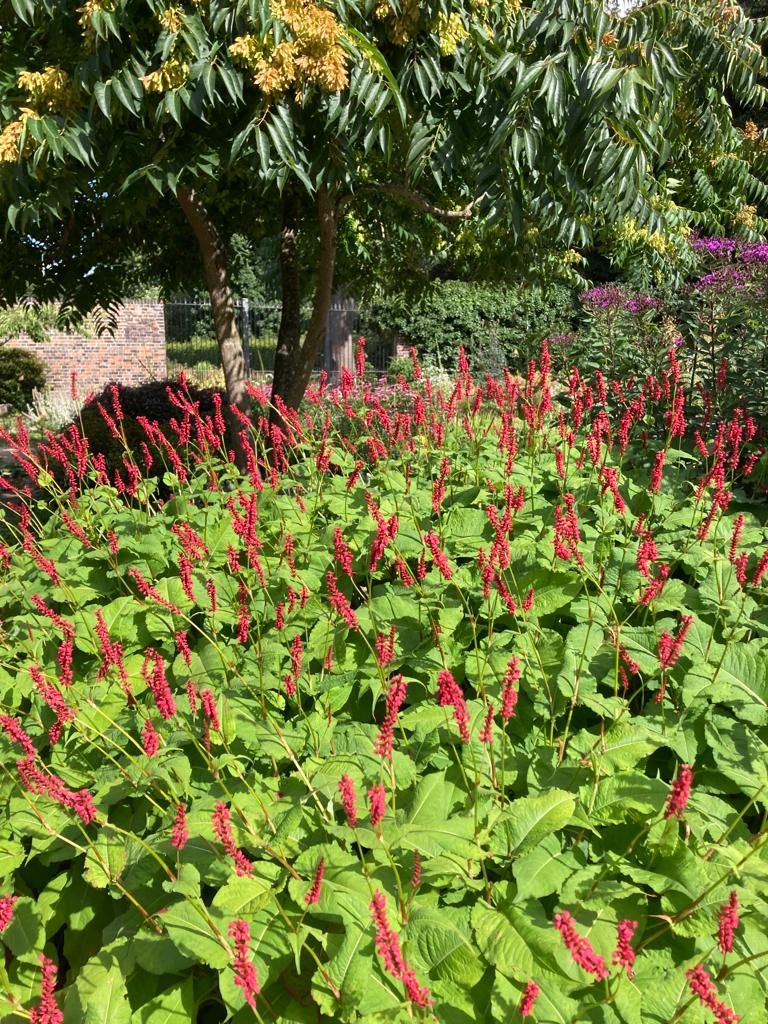
All the clumps of bistort in the garden have been grown from a single plant that was donated by a volunteer in 2021.
Bees and other insects love it!
Also look out now for beautiful seedheads, Echinacea shown here – spooky for Halloween!

Discover more from Charlton and Blackheath Amateur Horticultural Society
Subscribe to get the latest posts sent to your email.
 Charlton and Blackheath Amateur Horticultural Society