Before the 1920’s, the ten acres of land at Canford Cliffs was heathland. But along came a man with vision, one Thomas William Simpson, and, with the help of his head gardener Mr Middleton, a magical garden was created.
Mr Simpson was a businessman and entrepreneur (margarine) and having visited many countries, knew exactly what he wanted. Influenced by the gardens and architecture of Italy, Japan and the UK Arts and Crafts movement, he and his gardener set about creating a series of gardens, starting with the Italianate gardens, then a necklace of paths and ponds which connected finally to his Japanese Garden, thus turning his vision into reality, right up until WW2.
The garden sadly fell into neglect following the conflict, but in the 1950’s and 60’s, a new owner set about restoring it, planting the magnificent trees we see today – their maturity and majesty makes this garden quite a magical place to explore.
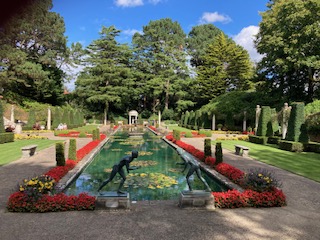

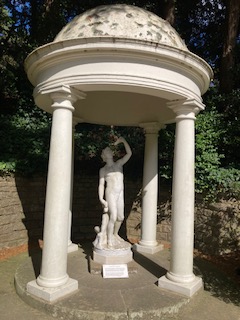
Upon entry into the garden, I came into the Roman Garden, passed through the Grotto and into the very impressive Grand Italianate Garden, the focal point being the rectangular formal pond and beyond, the statue of Bacchus, the Roman God of Wine, sheltering within a temple at the far end of the garden. This sheltered, south-facing, formal garden is a relaxing place to sit and admire its many features. This garden then leads into Palm Court, a formal garden with its row of impressive Chusan palms.

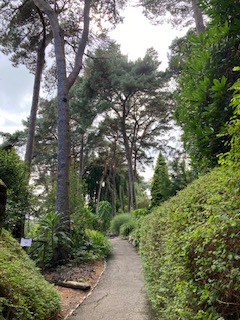
Leaving Palm Court, I enter into the informal section of the garden. I decided to leave the wooded valley for another time, and followed the interwoven paths on the upper level, around the Rock and Water Garden, noting the impressive collection of plants, of which there are over 300 species and suitably juxtaposed with one another. Everywhere I looked, there were impressive views through the trees.
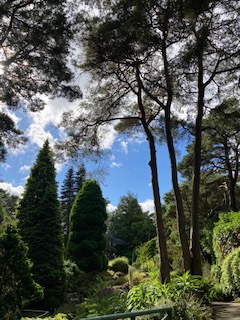


Passing through the Sculpture Garden and then the Heather Garden, admiring the tree heathers, I came across the Japanese Garden, which was truly impressive – the teahouse, the pond, the bridge, the stepping stones, the flowering water lilies – that I could have spent hours examining every placement and every planting. I can understand why Thomas Simpson brought in specialists to execute perfection within this garden. And it was perfection.
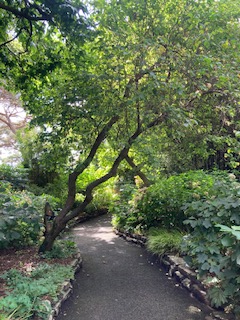


I wanted to retrace my steps to absorb much more but there was a lack of time, partly due to having sat in the sunshine enjoying luncheon in the courtyard at the on-site café for far too long! Next time I’ll explore the Wooded Valley, the Bog Garden and seek out the viewing points of Poole Harbour and beyond.


Anna L
Discover more from Charlton and Blackheath Amateur Horticultural Society
Subscribe to get the latest posts sent to your email.
 Charlton and Blackheath Amateur Horticultural Society