A couple of months ago, we noticed the damage that was being done to the fig tree in the Old Pond Garden and realised that most other fig trees in the area were in a similar state. What was happening?

We were discussing it at a volunteer session one day and Pat T indicated that she had spotted the same kind of damage on her fig tree and had contacted the RHS for advice. The RHS confirmed our suspicion that the cause is a micro-moth called Choreutis nemorana. It is being referred to as the fig-tree skeletonizer moth or fig leaf roller – for rather obvious reasons! This species is widespread in the Mediterranean and North Africa where there will be more fig trees but more natural predators too.
It was recorded in Belgium in 2009 and the first record for Britain was in 2014 in London. Since then it has spread to East Anglia, Kent and the Isle of Wight.
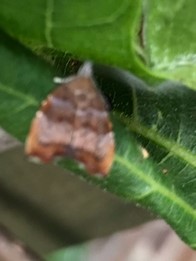
To understand what is happening to the fig tree, we must follow the life-cycle of the moth. The adult moth lays whitish eggs in batches on top of the leaf. The larvae or caterpillars then hatch, begin eating the leaf but just the tender bits, not the ribs (hence one of its names). They also spin silk to create a protective web or cocoon, under which they continue to eat the leaf until they pupate. There are two generations with adults flying in July and again in the autumn. The second generation over-winters in sheltered places. The caterpillar grows to about 15mm long and the moth has a wingspan of between 16 and 20mm. For more information and photos of the different stages check here.
The damage shown in the photos above is from the caterpillars eating the leaves. Their excretions known as ‘frass’ look like little black dots. You may also find other tiny scavengers taking advantage of what they are doing, such as the skin shed in the process of developing and pupating. Pat T mentioned tiny mites on hers. We don’t think they are harming the fig, just taking advantage of what’s there.

The RHS advise that the damage the caterpillar causes is often minor and if the tree is not otherwise stressed, it will tolerate the moths. We have found it difficult to judge the scale of the problem from current records. This seems to be because this little moth is a fairly recent migrant to the UK and moth recorders are not seriously looking for it yet (you’d be surprised what some people will do to find moths!). It is in danger of having the kind of impact the Box Tree Moth has had – except that fewer gardens have a fig tree. Growers in the Netherlands do not regard the damage there as minor, and while full-grown trees may be little affected, many young trees in our area are in a poor state.
The RHS advice is to manage the moth population by searching the rolled up leaves or webbing and squashing any caterpillars or pupae hiding there. Today, we checked a nearby tree and found some clean silk, opened it and found a caterpillar – so it’s not too late to check thoroughly. And do the same in Spring. Other management options for this moth are similar to those for tortrix moths listed here.
We recommend that anyone with a fig tree tries to manage their moth population by one of these means. We agree with the RHS that squishing is the preferred approach but if you want figs, stay vigilant!
Lynda & Joe F
(Members of the Garden Moth Scheme)
Discover more from Charlton and Blackheath Amateur Horticultural Society
Subscribe to get the latest posts sent to your email.
 Charlton and Blackheath Amateur Horticultural Society
My fig was wrecked by these last year, as I’d been a bit too tolerant. This year, I started squishing as soon as they appeared. The next day, there were just as many. I removed them. This continued for a week or two, with more damage appearing every day, until I admitted defeat. I’m going to get rid of the fig tree as it looks terrible and I can’t compete with these prolific creatures.
LikeLike
Oh dear! How old was your fig tree? Height and spread? And was it otherwise stressed, as the RHS describe? Suspect none of these things matter but interesting to gather a bit more evidence. Thanks
LikeLike
Planted in 2020, currently about 5.5ft height and spread so I was able to get to every leaf to squish, but to no avail. It was fine for the first couple of years and actually seems pretty healthy – it’s been growing new leaves for the past couple of weeks that are unaffected. I know of LOTS of other people with the same problem. I agree that it’s looking like a similar thing to the Buxus situation.
LikeLike
I have previously tried neem oil for rubber plant, and it worked magic. I am trying neem oil for my two suffering fig trees.
LikeLike
Please consider the RHS comment: “Be aware that products such as Neem Oil are not registered for use in the UK and we cannot advise on their use.” and, for more detail, read the article in the Horticulture Magazine on this topic at https://horticulture.co.uk/neem-oil/
LikeLike
what can I spray them with to kill them
LikeLike
We garden organically and therefore encourage predators to deal with pests. Sprays are particularly bad as they cannot be limited to the pest you are trying to deal with and are as likely to damage useful predators. This moth has few if any predators in this country so until this happens we suggest squishing as the most effective approach. The links to RHS advice show they agree. Good luck.
LikeLike
Are any varieties particularly at risk? Our two Brown Turkeys in Charlton Slopes, planted more than 40 years ago (before “Charlton Slopes” was a thing) and now visible on Google Earth, have fortunately seen no sign of this so far.
LikeLike
Most of the fig trees we’ve examined we don’t know the variety but it appears that small/medium sized trees suffer more damage. We have a very young one which seems OK so far. The one in the corner of the Old Pond Garden is medium sized and we are squishing caterpillars every time we check it at the moment. Good luck.
LikeLike
I have two ‘trees’ grown from cuttings 4 years ago in my Sidcup garden. The larger which is about 6 foot tall has been producing fruit for 2 years – last year 6 edible fruits, this year lots more. The smaller one has just started to produce fruit but is only 2 foot tall.
Sadly the larger one has been badly affected by moths this year. Before I knew what they were I removed all the affected leaves. The fruit has not been affected.
Thank you for the information in this article. It will help me going forward, to deal with this problem in the most environmentally friendly way I can
LikeLike
I have just come across this thread whilst trying to find out what’s happening with our very old fig tree. We’re in Essex. It was slightly affected last year but looks dreadful this summer, despite a hard pruning early on. New leaves are growing but soon munched. It’s a massive statement tree, maybe 40-50yrs old. Probably a lot older Getting to the top is impossible.
Do we really think figs are going to be like the box? Shame
LikeLike
It is like the Box Tree Moth in that it feeds on the leaves but it does not seem to affect fruiting on the fig. We need a predator to find the caterpillars! Till then, it’s up to us to deal with them. Locally to us, established trees are damaged but not destroyed by the caterpillar.
LikeLike
I live in Enfield North London and I have the same problem. As do my friend up the road and her neighbour. There are just too many of them and I cut my tree back in March/April so all the leaves were gone it was bare branches. There must be some cure somewhere please help
LikeLike
We need a predator to find the caterpillars! We have heard of a predatory wasp but have no details.
LikeLike
I have the same problem, and I am trying to spray neem oil.
LikeLike
Please consider the RHS comment: “Be aware that products such as Neem Oil are not registered for use in the UK and we cannot advise on their use.” and, for more detail, read the article in the Horticulture Magazine on this topic at https://horticulture.co.uk/neem-oil/
LikeLike
In ddesperation I tried neem oil and it’s working very well. I also hunt daily for leaf roll but since using neem oil any caterpillars inside are already dead. Does anyone know why neem oil is not approved in this country? I’ve read that professional growers abroad use it regularly
LikeLike
I can only direct you to the RHS comment: “Be aware that products such as Neem Oil are not registered for use in the UK and we cannot advise on their use.” and, for more detail, read the article in the Horticulture Magazine on this topic at https://horticulture.co.uk/neem-oil/
LikeLike
I inherited an old, 20ft high by about 12/14 ft wide fig tree, when I moved 3 years ago. We hard pruned it the first year we were here, as it was very overgrown and had never had fruit. Last year we had a few figs but this year we were hopeful for more, It is now covered in fig moth, I tried pinching them and removing leaves but it is too large so, they have decimated all the leaves. (They are now eating next year’s fruit too). Please help as I really don’t want to get rid of it but it really does look sad. I leave in Great Yarmouth.
LikeLike
Are you sure it is the moth caterpillar eating the fruit? It may be something else. We have only seen them eating leaves. A large tree is more difficult to manage but larger trees are also more able to cope with damage from the moths. Good luck..
LikeLike
These voracious devils have decimated my 20 year old brown turkey in South Norfolk during this summer, it’s way too big for me to get everywhere to squish and who has the time to do that!
I hope we have a very cold winter and that kills them off and they do not reappear next year, if they do it’s time for a rethink and what was a wonderful tree will likely have to go.
If there was a killer spray I’d use it to save the tree, just being real!
LikeLike
I live in Gorleston on sea , Norfolk and have mature fig tree ( about 15 years old) It started last year and I tried to squish them – it didn’t seem too bad but this year has been a disaster . What makes it doubly awful is that you get the early summer ones and then suddenly they are back with vengeance. I have found their webbing between the small fruits too where they seem to be eating the surface of them
Really horrible creatures.
LikeLike